
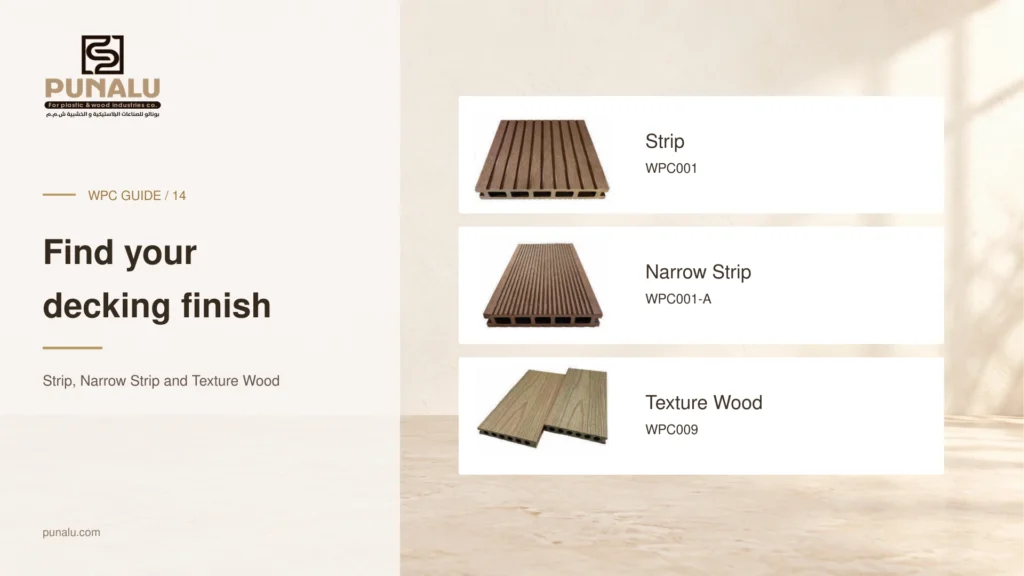
A decking surface influences the character of a terrace and the way its details come together. PUNALU lists Strip, Narrow Strip and Texture Wood decking options in its product catalog. Begin with these identified products and their actual samples when choosing a finish for your project.
This guide explains how to compare the visible surface, board direction and surrounding finishes while keeping technical questions tied to the selected product. A surface description does not establish the board's complete construction or performance. The aim is to make a clear, documented choice that can move from sample review to material order.
Understand the listed surface options
The Strip product is listed as WPC001, Narrow Strip as WPC001-A and Texture Wood as WPC009. Their catalog images show different surface patterns. Use the exact names and codes when requesting samples so that everyone discusses the same options.
A broad strip pattern can create a different visual rhythm from finer lines or a wood-textured surface. Judge the effect beside the architecture rather than assuming one is universally better. A finish that works in a quiet courtyard may create a different impression across a long terrace.
Treat these as product choices, not merely alternative pictures of an identical board. Ask whether dimensions, accessories or installation details differ between the shortlisted codes. A finish change may require a specification review as well as a visual decision.
Compare samples at close range and across the space
At close range, examine the pattern, texture and appearance of the edges. Then place the samples on the site and step back. Look from the main doorway and normal seating position, where the overall direction and repetition matter more than an isolated detail.
Use several samples or a representative arrangement where available. One small piece cannot fully show how joints and repeated lines will look across a larger area. Ask the designer to sketch the direction and the main visible transitions.
Keep each sample labelled with its product code. If you photograph the review, include that label in a separate reference shot. This avoids losing track of similar options when images are circulated among the owner, designer, supplier and installer.
Coordinate the finish with the board direction
Strip patterns emphasise the direction of the boards. Consider how that direction relates to walls, doors, seating and the main route through the space. Review a small number of layout options instead of choosing the surface and layout independently.
The preferred visual direction must also work with the approved floor arrangement. Ask the contractor to coordinate it with the supporting structure, joints, perimeter and required access. A drawing should show both the intended appearance and the details needed to achieve it.
Confirm the intended visible face of the selected board. Do not treat the reverse side as an alternative decorative finish without written confirmation. The sample should be viewed in the orientation that will actually be installed.
Assess colour beside existing materials
Choose a short list of colors from the relevant PUNALU options, then request physical samples for the product being considered. Review them beside the actual paving, stone, wall finish and metal frames. Similar color names do not guarantee the same appearance across different products.
Observe the samples in daylight and the artificial lighting relevant to the space. A warm light source, strong sunlight or shade can change how the material appears. Phone photography is useful for discussion but should not become the final color standard.
Record the approved product and color codes together. Confirm that the chosen combination is currently offered before completing the order. Keep the reference sample accessible during delivery and installation so that later checks use the same basis.
Separate texture from performance claims
A deeply grooved surface may look different from a wood-textured one, but appearance alone does not establish slip performance, stain resistance or a particular service life. Request the information relevant to the exact product where the project has defined requirements.
For pool surrounds or other wet areas, discuss the intended application and required evidence with the project professional. The decision also needs to consider drainage, levels and the complete floor arrangement. A finish name cannot settle those questions by itself.
For sunny spaces, review shade and expected use as part of the design. Do not promise that a color or surface will remain comfortable under all weather conditions. Ask practical questions about the site rather than relying on a general marketing description.
Ask how the chosen surface should be cared for
Request cleaning guidance for the selected PUNALU product before approving the finish. Explain whether the deck will sit beneath trees, beside planting or near an outdoor dining area. These conditions help frame the maintenance discussion.
Ask which tools and cleaning products are suitable and how to handle spills or marks. Do not copy instructions for an unrelated board solely because its surface looks similar. Keep the relevant care information with the project records for the person responsible after handover.
Consider whether the layout leaves the required maintenance access. Plant pots, furniture and removable items should be planned with everyday care in mind. A finish is easier to manage when the care routine and access needs are understood before installation.
Check finish changes against the complete specification
If the chosen finish changes during design, update the product code on the drawing, sample record and quotation. Ask the supplier and installer whether the change affects the lengths, take-off, compatible accessories or installation details.
Do not allow a visual substitution to pass through as a minor color change when it actually introduces another profile. Review the alternative as a complete product. Keep any agreed change in writing so that purchasing and site teams work from the same selection.
Before ordering, check the approved sample, code, quantity, supply scope and delivery requirements together. This final review is particularly useful when several stakeholders have commented on different samples over time.
Frequently asked questions
Are Strip and Narrow Strip the same finish?
PUNALU lists them as separate named products with different codes. Compare the current physical samples and product information to choose the appearance and specification suitable for your project.
Does a wood-textured finish prove that a board is capped?
No. A visible pattern does not establish how the surface is manufactured. Ask for the exact product construction if a coating or cap layer is relevant to your specification.
Can I approve the finish using the website image alone?
Use the image to form a shortlist. Confirm the product, color and visible face using a physical sample and current supplier information before placing the final order.
Review your surface options with PUNALU
Send PUNALU photographs of the project and the decking codes you want to compare. Request the applicable samples, care information and compatible accessories. Review the options with your designer or contractor, then record one approved product and finish combination for the material order.
Sources and product guidance
Use the selected product documentation. Other manufacturers’ guidance applies to their own products.