
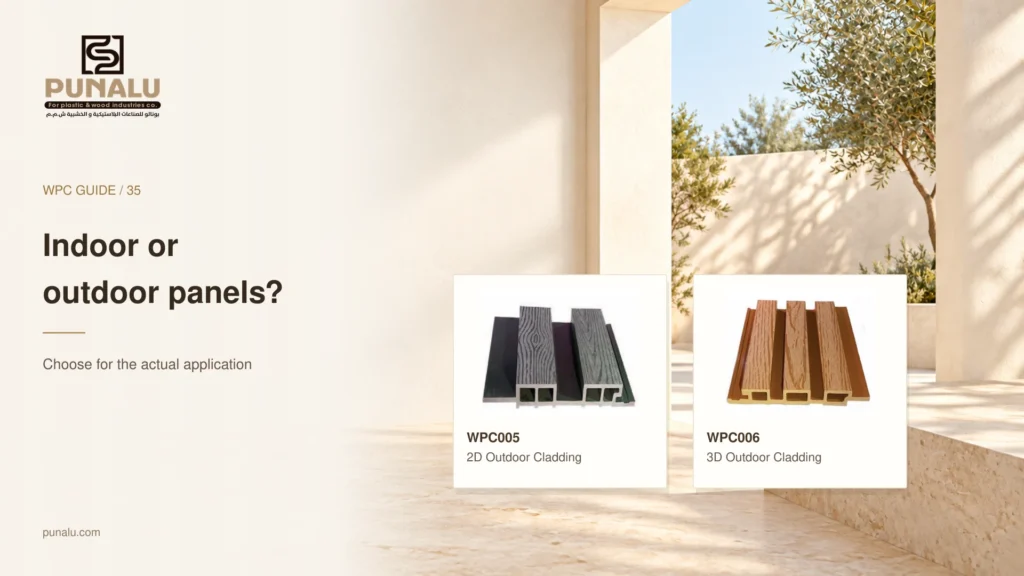
Two wall panels can share a wood-inspired finish while being intended for different conditions. A decorative panel shown in a living room should not be assumed suitable for an exposed boundary wall. Likewise, an outdoor product still needs the correct assembly and installation detail. Check the exact product, intended application and supporting documentation before using appearance as the main selection criterion.
Describe the actual location
Record whether the wall is indoors, outdoors or partly sheltered. Identify direct sun, wind-driven rain, nearby planting, cleaning practices and access requirements. A covered entrance is not identical to an enclosed room, and a bathroom is not simply an outdoor application moved inside. Give the supplier photographs and a written description so that its response addresses the conditions the material will actually face.
Read the product identification
PUNALU’s catalog labels WPC005 2D Outdoor and WPC006 3D Outdoor as outdoor wall panels. These references provide a useful starting point when discussing an external wall. Keep the product code on the quotation and sample approval. Do not replace that identification with a general description such as “wood alternative panel,” which can refer to several different materials and intended uses.
Ask what the evidence covers
Request the current technical information relevant to the intended location. Clarify whether the documentation describes the panel alone or the installed assembly. Where the project requires particular fire, exposure or fixing performance, have the responsible designer review the evidence. A promotional phrase about durability cannot establish all of these requirements, and the same manufacturer may offer products for different applications.
Check the wall construction
Determine what the panel will be fixed to and how the supporting arrangement interacts with the existing wall. Outdoor assemblies may require coordinated weathering, movement, drainage or ventilation details, depending on the system. Indoor assemblies also need suitable substrates and fixing methods. Read PUNALU’s cladding selection guide, then obtain instructions specific to the selected product rather than borrowing a diagram from an unrelated system.
Review service and opening details
Mark lights, sockets, inspection covers, windows and doors before finalizing the layout. Decide how access will be preserved and how the material will terminate at each interruption. In wet or exposed areas, the relevant trades should coordinate the interfaces with the underlying building. A decorative surface should not conceal an unresolved leak, obstruct a drain or remove access to a component that needs maintenance.
Inspect samples in context
Review the actual profile, colour and surface beside the proposed adjoining finishes. For an external wall, look at the sample under representative daylight and from the normal approach route. For an interior feature, consider artificial lighting, furniture and the viewing distance. Do not assume that a digital photograph accurately predicts how a large repeated panel arrangement will appear in your particular space.
Keep care instructions application specific
Ask how the selected surface should be cleaned and which products or tools are permitted. The existing panel maintenance article introduces the subject, but the final care routine should follow the product’s current instructions. Include any access requirements in the design. A panel placed beyond easy reach creates a different cleaning task from the same finish installed at ground level.
Prepare a application brief
Use one page to record the location, substrate, exposure, opening details, required appearance and cleaning access. Attach photographs labelled by location. Send the same brief with each sample request so the supplier understands the conditions behind the selection. If the proposed location changes during design, revisit the product recommendation rather than assuming the response still applies. The brief should evolve with the application, not remain attached to an outdated concept.
Browse PUNALU’s wall panel catalog, identify the relevant product and send the team your project details. A clear application brief allows the material proposal to be reviewed against actual conditions, helping you choose a panel and assembly that belong together rather than relying on a familiar colour or generic category label.
Sources and product guidance
Use the selected product documentation. Other manufacturers’ guidance applies to their own products.