
WPC and PVC wall cladding can appear in the same shortlist because both may offer a decorative panelled finish. However, similar photographs do not establish similar composition, intended use or installation requirements. Before comparing prices, identify exactly what each supplier means by the product name and where that product is approved to be used.
This guide provides a practical comparison framework for homeowners, designers and purchasing teams. It focuses on the questions that make two quotations genuinely comparable, without declaring one material category the winner for every interior or exterior wall.
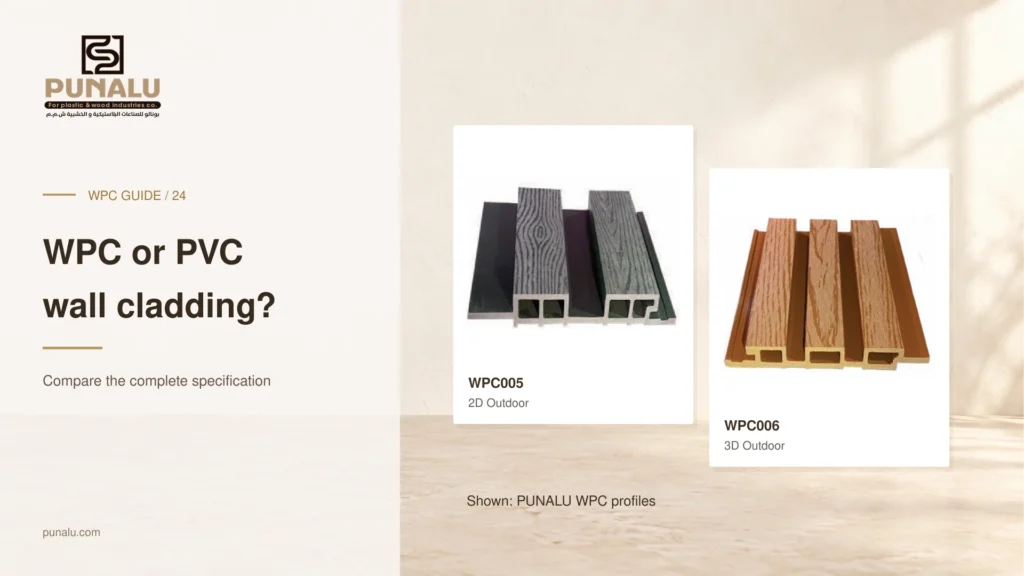
For a PUNALU enquiry, start with its identified WPC wall-cladding profiles, such as WPC005 and WPC006, and their current product information. The cover shows PUNALU WPC profiles only. Any PVC alternative should be identified separately by its own supplier, code and technical documents; the comparison does not imply a PUNALU PVC wall-panel offering.
Clarify what the names describe
WPC stands for wood-plastic composite: a combination containing wood-based material and a polymer, with the detailed formulation varying by product. PVC refers to polyvinyl chloride, a polymer that may be used in different panel constructions. These labels describe different aspects of a product and should not be treated as complete specifications.
A useful complication is that a WPC formulation can itself use PVC as the polymer. Therefore, “WPC versus PVC” is not always a simple comparison between two mutually exclusive ingredients. Ask whether the quoted panel contains wood-based material, how the panel is constructed and what its technical sheet actually says.
For a buying decision, write the exact product codes beside the category names. This avoids comparing a known panel with a vague description that could refer to several different products.
Confirm the intended application first
An interior decorative panel should not be assumed suitable for an exposed façade. Likewise, a product used in a sheltered location may have conditions that do not cover a different exposure. Ask whether each shortlisted panel is intended for the actual wall, location and environment in your project.
Describe whether the installation is indoors, outdoors, beneath a canopy or near an area that is regularly washed. Mention any unusual use, such as a high-contact public corridor or a wall behind frequently moved furniture. These details help the supplier answer the application question precisely.
If the intended use is not covered clearly by the documentation, request clarification before proceeding. An attractive sample is not enough to resolve an uncertainty about the permitted application.
Compare the whole wall assembly
Cladding is part of a wall arrangement that can include the substrate, supporting battens or rails, fixings, membranes, trims and junction details. Ask how the proposed panel will be supported and how it will meet windows, doors, corners and other finishes.
For exterior applications, review weather management with the responsible designer. A decorative panel should not be assumed to replace all underlying water-control layers. Manufacturer systems may have specific drainage, ventilation or barrier requirements, which must be understood for the actual assembly.
Record whether each quotation covers the panel only or the compatible accessories too. A lower panel price can be misleading if the other option includes the components needed to achieve the finished detail shown in the design.
Evaluate appearance with representative samples
Compare more than one small offcut where possible. Look at the scale of the pattern, the depth of the profile, the joint rhythm and the appearance of a finished corner. A panel that looks convincing close up may create a different effect when repeated over a large wall.
Place samples beside the project’s actual flooring, frames and furniture. View them under the intended lighting, including artificial lighting if the space is mainly used in the evening. Check whether the design depends on a particular orientation and confirm that orientation is permitted for the selected system.
Ask how colour and surface variation are managed within the product range. Keep the approved sample and code with the order so that delivery checks have a clear reference.
Request evidence for performance claims
If a project requires a fire classification, impact performance or another defined criterion, ask for the relevant report for the exact product and assembly. A general statement that a category is “safe,” “waterproof” or “heavy duty” is not a substitute for a documented requirement and matching evidence.
The responsible project professional should check what the report covers and whether it applies to the proposed use. Do not transfer a classification from one thickness, substrate or assembly to another without confirmation. The test document needs to be read in context rather than reduced to a logo on a brochure.
For everyday care, request cleaning instructions and ask how damaged panels can be accessed or replaced. These practical questions often make the differences between two proposals clearer than broad marketing descriptions.
Compare cost using the same scope
Create a schedule that separates panels, supporting components, trims, fixings, delivery and installation. Include the agreed waste allowance and any special details. Confirm whether prices refer to gross panel area or the coverage achieved after the panels are joined.
Review available lengths and the proposed layout together. A different panel size may change the number of joints or offcuts, so equal wall areas do not always produce equal purchasing quantities. Have the installer verify the take-off against the approved drawing.
Finally, compare warranty terms and maintenance obligations. Note who provides the warranty, which application it covers and what exclusions apply. Keep product supply and workmanship responsibilities distinct in the project records.
Frequently asked questions
Is WPC always better than PVC wall cladding?
No. Choose between actual products according to the application, appearance, documented performance, installation system and complete cost. The category name alone cannot settle the decision.
Can I use an interior panel outside?
Only if the exact product documentation permits the proposed exterior use. Do not assume that a similar-looking outdoor panel makes an interior product suitable for the same location.
Are all PVC panels wood-free?
Check the technical sheet and terminology used by the supplier. PVC is a polymer name, and it can also appear within a wood-plastic composite formulation. Product descriptions need clarification rather than assumptions.
Compare the specification with PUNALU
Send PUNALU the wall dimensions, location, photographs and required finish when enquiring about WPC cladding. Ask for the available product details and compatible accessories, then compare them with any alternative on the same basis. A clear specification makes the choice more useful than a broad material-versus-material verdict.
Sources and product guidance
Use the selected product documentation. Other manufacturers’ guidance applies to their own products.