
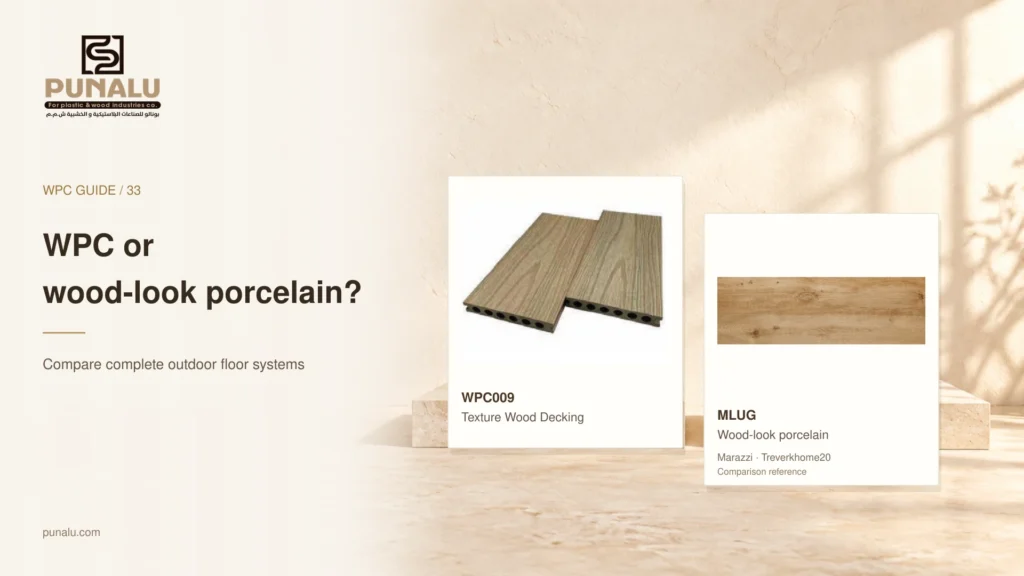
WPC decking and wood-look porcelain can both contribute to an outdoor design with a timber-inspired appearance. Choosing between them requires more than comparing photographs or a surface price. Each proposal needs a product suitable for the intended location and a compatible installation assembly. Assess the terrace as a complete project, including levels, drainage, access, daily use and the appearance you want to achieve.
Compare identified products
Start with a named WPC decking profile and a specific porcelain collection approved for the intended exterior floor. The term “wood look” describes appearance, not application suitability. Review PUNALU’s flooring range for actual decking references, then ask the tile supplier for the corresponding product documentation. Avoid comparing a documented outdoor product with an unspecified sample selected only because its colour matches.
Understand the construction proposal
For WPC, establish the permitted support and fixing arrangement for the chosen boards. For porcelain, establish the substrate and installation method approved for the selected tile. Neither material name defines a complete system. Do not assume that every tile can be used on pedestals or that decking can be fixed directly onto any existing surface. Ask the contractor to explain each proposed build-up.
Check levels and drainage
Compare the complete finished height at doors, steps and adjoining paving. Ask how water will leave the surface and how underlying drains will remain accessible. This is especially important on balconies and rooftops, where the floor proposal must be coordinated with the existing building and waterproofing. A visually continuous surface should not make an inspection point or maintenance route impossible to reach.
Review comfort and surface evidence
Evaluate samples in the actual exposure conditions, including areas used barefoot or after rain. Neither a wood-grain appearance nor a textured finish is proof of comfort or slip performance. Request evidence relevant to the exact product and application. Discuss shade, cleaning practices and expected use with your designer. An informal sample test can inform preference, but it is not a substitute for specified performance evidence.
Compare appearance at installation scale
Place several pieces together to understand repetition, joints and the relationship with nearby finishes. With WPC, compare the actual surface and board profile; Texture Wood decking is one catalog reference. With porcelain, review tile dimensions, pattern variation and the proposed joint layout. Judge both options from normal viewing distances, rather than comparing a close-up sample with a finished architectural photograph.
Consider cleaning and replacement
Ask each supplier for the applicable care instructions and the process for replacing a damaged piece. Check whether furniture, planters and access panels change that process. Read PUNALU’s cleaning and maintenance article as background, then obtain the instructions for the exact decking product. The tile alternative needs its own guidance for the tile, joints and installation materials rather than a borrowed WPC routine.
Price the complete alternatives
Compare materials, supporting or setting components, edge details, delivery, preparation and installation. Identify exclusions and record the maintenance assumptions used in the decision. The existing WPC quotation guide can help structure the WPC side. A lower surface price does not establish the lower project cost when the assemblies and required preparation differ.
Make the decision transparent
Create a short comparison sheet with the same headings for both proposals: approved application, complete build-up, finished level, drainage access, appearance, care and total scope. Mark unanswered questions explicitly instead of assigning imagined performance scores. Where one option needs extra preparation, include that work before comparing totals. This turns a personal surface preference into a decision the client and contractor can understand, while preserving the role of the project designer in confirming suitability. Retain the completed comparison with the accepted quotation for future project reference.
Share your measured layout and intended use with PUNALU to discuss the decking option. Ask your designer to compare it with the specified porcelain proposal against the same project brief, then choose the documented system that best fits your space and operating needs.
Sources and product guidance
Use the selected product documentation. Other manufacturers’ guidance applies to their own products.