
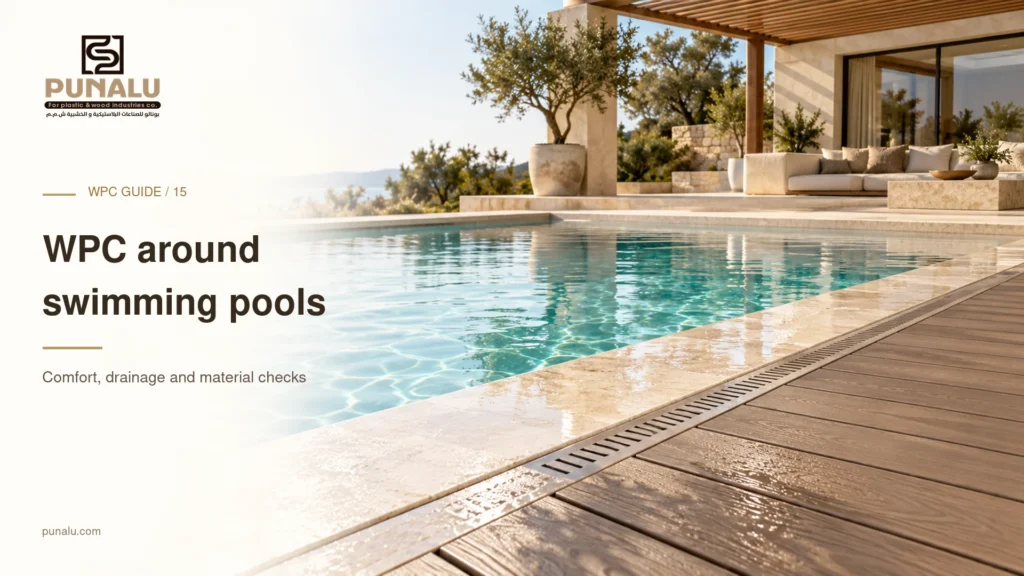
Choosing WPC pool decking starts with understanding the conditions beside the water. The surface may be walked on barefoot, splashed repeatedly and cleaned more often than a quiet garden terrace. It also meets coping stones, drainage channels and access points. An attractive colour is only one part of this decision.
The most useful brief describes who uses the pool, where people enter and leave the water, and how the surrounding area is maintained. Give that brief to the material supplier and the project designer together. It creates a basis for checking a particular decking system rather than relying on a general claim that all composite boards suit wet areas.
Confirm that the product suits the application
Ask whether the exact range, profile and fixing system are approved for the proposed poolside use. Request the written documentation that supports the recommendation. Keep pool surrounds distinct from products intended for permanent immersion or other water-contact conditions.
A manufacturer's pool application page may describe its own product capabilities, but those capabilities should not be transferred to a different brand. For PUNALU, ask for the current information attached to the proposed material. If the application requires particular performance evidence, identify it before comparing quotations.
Make a simple location plan showing areas immediately beside the water, dining areas, shaded corners and routes back into the building. This helps the team identify where different details or surface requirements may apply, even when the overall design uses a coordinated colour palette.
Evaluate traction using relevant evidence
Ask for applicable wet-surface testing or classification for the selected finish. The name of a texture is not a test result, and a deeply patterned sample should not automatically be described as slip-proof. Request an explanation of what the evidence covers and what conditions it does not represent.
Discuss the requirements with the project designer, especially for commercial pools or spaces used by children and older people. Product selection, drainage, cleaning and the overall arrangement of the area need to work together. A surface specification cannot compensate for every possible operating condition.
Include maintenance in that discussion. Ask how the team will remove debris and deal with contamination, and ensure the care instructions are available to the people actually cleaning the area. An approval meeting that excludes operations can miss practical issues that appear after handover.
Plan for comfort in direct sunlight
Composite surfaces can become hot in direct sun. Trex explicitly notes this in its product guidance, including for ranges with heat-mitigating technology. Do not interpret a wood-look finish as a promise of barefoot comfort throughout an Egyptian summer afternoon.
Review the amount of shade and the expected route from seating to the pool. Assess physical samples under representative site conditions without treating a casual touch test as certification. Ask the supplier for any applicable temperature information and discuss colour options alongside the shading design.
If the project is frequently used at midday, make that clear in the brief. It is easier to consider shaded routes, seating placement and material transitions before the layout is fixed than to address comfort after the deck has been ordered.
Coordinate coping and drainage
The junction between decking and pool coping deserves a drawn detail. Ask the designer to show the finished levels, permitted movement, drainage route and edge support. The exact arrangement should follow the selected system and the pool construction, rather than a dimension copied from an unrelated project.
Review where cleaning water and splash water will travel. Show drainage access points on the drawing and ensure they remain reachable once furniture and planters are in place. A visually continuous surface should not conceal components that require regular inspection.
Before installation, have the responsible contractor confirm that the underlying conditions match the approved design. During handover, request a demonstration of access to drains or service points. This turns a hidden detail into something the owner knows how to manage.
Discuss pool chemicals and cleaning
Tell the supplier which cleaning products and pool-treatment practices the site uses. Ask for written care guidance and any relevant restrictions. Keep chemical storage and dosing activities separate from assumptions about normal splash exposure.
Prepare an operating routine that the cleaning team can follow. It should identify the approved cleaner, tools, rinsing procedure and escalation contact for unusual staining. Avoid borrowing a pressure-washer setting or solvent recommendation from another decking brand.
If a mark appears, record when it was noticed and what happened nearby before attempting an aggressive treatment. Useful information helps the supplier advise on the next step and reduces the temptation to experiment with products that may be unsuitable.
Include access and replacement in the layout
Identify equipment lids, lighting connections and other service points before setting board direction. Ask how an individual board would be removed if access or replacement became necessary. A concealed fixing system should be assessed for the actual maintenance needs of the pool area.
Keep a labelled sample and record the installed product codes. Where spare material is included, agree a protected storage location and inventory. These small handover decisions make future communication easier without promising that a later production batch will look identical.
Questions to resolve before ordering
Is every WPC board suitable around a pool
No category-wide assumption is appropriate. Confirm the intended use, relevant surface evidence and installation instructions for the exact product being supplied.
Does a textured finish guarantee safety when wet
No. Ask for relevant testing and consider drainage, cleaning and site use with the responsible designer. Avoid absolute claims based only on appearance.
What information should I send with an enquiry
Provide the pool layout, decking area, expected use, exposure, coping detail, drainage locations and maintenance arrangements. Include photographs when the project is an existing renovation.
Prepare the poolside specification first
Bring the supplier, designer and installer into the conversation before choosing the final colour. Contact PUNALU with your project brief to request suitable current options and supporting information. The result should be a coordinated material proposal that addresses poolside use, rather than a board selection disconnected from the rest of the space.
Sources and product guidance
Use the selected product documentation. Other manufacturers’ guidance applies to their own products.