
It is easy to compare two WPC boards by colour or quoted price. That comparison rarely reveals whether either board is suitable for the site, or whether the quote includes a complete system. WPC is a category of materials; the inputs, profile design, manufacturing process, and installation details determine what an individual product is designed to do.
Before asking for the lowest WPC price, ask a more useful question: what is this profile made from, how is it controlled during production, and what specification can I review? This article explains the core components in plain language and turns them into practical questions for a buyer, designer, contractor, or developer.
The basic components in WPC
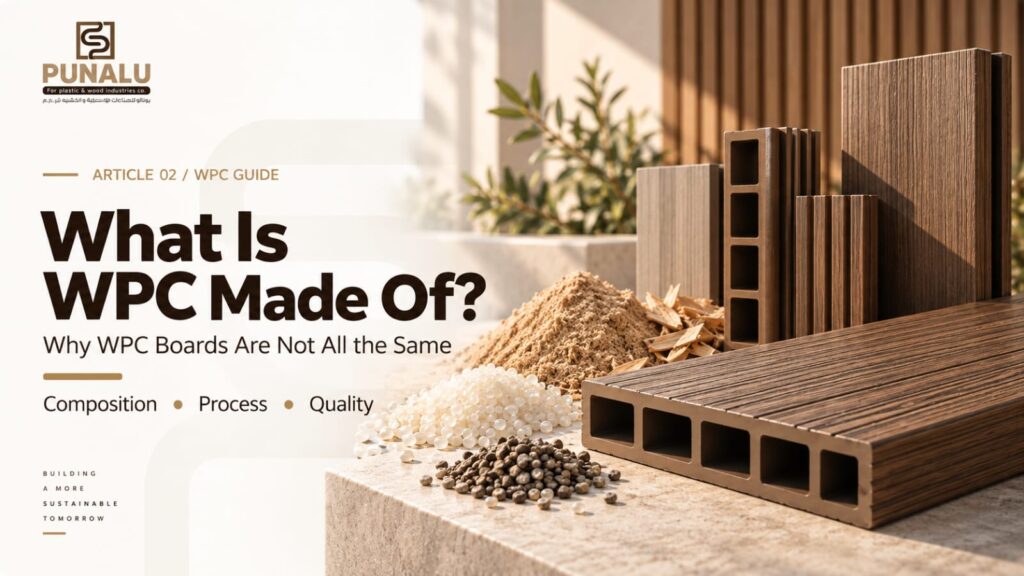
WPC generally contains a wood-based fraction, a polymer fraction, and a set of performance additives. The wood-based part contributes to the material’s character and texture. The polymer binds the mix into a usable profile, while additives are selected for processing and product-specific performance needs such as consistency, workability, or exterior use.
Listing these components is not the same as proving quality. A buyer should also understand whether the supplier can identify the inputs, explain the profile specification, and provide a sample that matches the material being offered. Clear answers, a physical sample, and written documentation are far more useful than technical words used without evidence.
Why polymer choice matters
The polymer is part of the engineering decision because it influences how the composite is formed and how the profile is intended to behave. Buyers do not need to become material scientists, but they should be able to ask whether the product inputs are defined, whether the supplier has a data sheet, and whether the offered sample represents the delivered board.
If a supplier describes virgin content, recycled content, or a particular polymer type, ask for the relevant written product information and confirm that the claim applies to the exact range you are considering. This keeps the comparison grounded in the actual product rather than in broad marketing language.
The role of wood fibres or wood flour
The wood-based component contributes to the profile’s visual and tactile character, but it must be part of a balanced system rather than a label on the packaging. Ask about batch consistency, surface finish, dimensional accuracy, and the recommended application. A profile selected for a wall finish may not be the right choice for a deck with regular foot traffic.
These questions explain why WPC should not be purchased as one standard, interchangeable commodity. The project has a specific use, and the profile should be selected for that use rather than for the general name of the material alone.
Additives and production control: what a photo cannot show
Even when the inputs are appropriate, mixing, extrusion, finishing, and inspection matter. A controlled production approach reviews incoming materials, weighs and blends them consistently, then checks colour, dimensions, surface quality, and profile condition. That process is what separates a traceable product system from one with little supporting information.
Avoid relying on unqualified phrases such as “best quality.” Ask for proof that there is a system: product samples, profile details, installation instructions, written warranty conditions, or examples of comparable work. In larger projects, this documentation is more valuable than a visual comparison on a phone screen.
Five questions to ask before buying
Ask about the core material inputs, the intended use of the profile, board thickness, the accessories and installation system, and what the warranty actually covers. Then ask to see a sample or a relevant completed project. If the response is vague, do not let price be the only deciding factor; the comparison may not be between equivalent systems.
Using this list changes the decision from “Which colour looks better?” to “Which system gives this project a clearer basis for approval?” That is the right starting point for a material that needs to fit both the design concept and the practical conditions of the site.
Frequently Asked Questions
Does WPC quality vary with the composition?
Yes. Products can vary by inputs, ratios, production control, profile design, finishing, and installation system. Ask for a data sheet and a sample.
What is the most important document to request?
Start with the product specification, written warranty terms, and installation guidance, then compare them with the actual sample and intended application.
Next Step for Your Project
Comparing more than one WPC offer? Send PUNALO the available profiles or specifications. The team can help you turn the visible differences into practical questions before you request samples or pricing.