
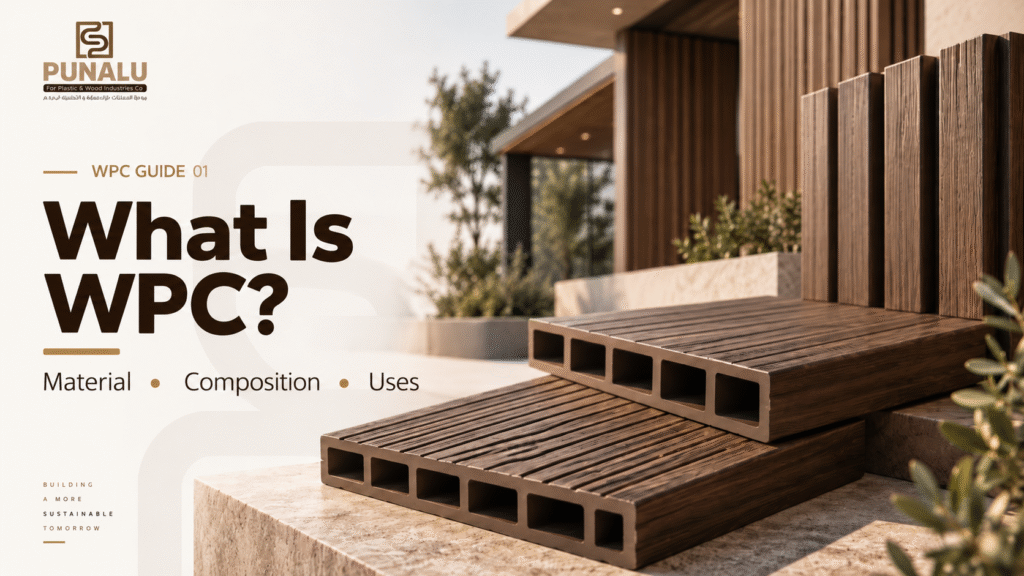
When a villa, chalet, hotel, or commercial outdoor area is being planned, one question appears early: should the project use natural timber, or a wood-look architectural alternative that fits a different maintenance model? Wood Plastic Composite, commonly called WPC, is a composite material used in many exterior applications, including decking, wall cladding, pergolas, fences, and privacy screens.
Knowing that a product is called WPC is not enough to make a sound buying decision. The finished result depends on the material specification, profile design, manufacturing consistency, installation system, and the realities of the site. This guide explains WPC in practical terms and turns the topic into a useful checklist before you ask for prices or choose a colour.
What does WPC mean?
WPC stands for Wood Plastic Composite. It describes a material family that combines a wood-based component with a polymer and performance additives, then forms that mixture into architectural profiles. It is not one identical board sold everywhere. Different manufacturers can use different inputs, profile thicknesses, finishes, fixing details, and quality-control processes.
That is why the surface appearance should never be the only selection criterion. Two profiles can look similar in a catalogue yet be designed for different conditions or installation methods. A good comparison begins with a written specification, continues with a physical sample, and then checks whether the supplier can explain how the system is intended to perform in a project like yours.
Where is WPC used?
Outdoor decking is one of the most common uses for WPC. It can be specified for gardens, terraces, roof decks, pool surroundings, hospitality areas, and walkways. WPC profiles are also used for façade cladding, decorative screens, pergolas, fencing, and privacy dividers. Each application needs a suitable profile and fixing approach; one generic board should not be assumed suitable for every situation.
In a residential project, the objective may be a more usable terrace or a neat garden zone for the family. In hotels, restaurants, and resorts, movement patterns, access for cleaning, visual consistency, and the ability to repeat a detail over a larger area become more important. Define the job of the space before comparing colours or price-per-square-metre figures.
Why is WPC considered for outdoor spaces?
Many buyers explore WPC because they want a wood-inspired visual language in an exterior system. Natural wood has its own character and appropriate uses, but it comes with a maintenance decision that depends on timber species, treatment, exposure, and care plan. WPC is usually considered when the project needs a more regular architectural finish for a deck, cladding surface, divider, or shade structure.
This does not mean that every WPC product is automatically suitable for every climate, surface, or use. Direct sun, water, dust, foot traffic, coastal exposure, ventilation, and thermal movement all affect the recommendation. The clearer the project brief is, the more accurate the profile and installation recommendation can be.
How do you recognise a well-specified WPC system?
Start with the fundamentals: ask what the product is made from, whether the profile has a written specification, how thick it is, and how accessories, subframes, drainage, and fixing points are handled. Then ask for a sample, written warranty terms, installation guidance, and maintenance instructions. These questions are more valuable than a product photo or a single metre-rate without context.
It also helps to view a real installation or at least inspect the sample in natural light. Colour and texture are perceived differently on a screen than they are beside stone, paint, aluminium, or planting. PUNALO can frame the decision around a useful question: what is inside the profile, and what evidence supports the answer? Apply the same standard to every supplier you compare.
What should you prepare before requesting a quotation?
Prepare the intended use, approximate area, city, site photographs, and target installation date. For decking, explain the existing base, drainage condition, water exposure, and levels. For façades, pergolas, or fences, provide dimensions, elevations, fixing conditions, and any required privacy or shading effect. These details prevent a generic quote that does not represent the actual system cost.
This turns the conversation from “What is the price of WPC boards?” into a structured conversation about a complete system. Once the use is clear, the project can move to more specific guidance on decking, cladding, pergolas, fencing, or doors, followed by a sample and a documented recommendation.
Frequently Asked Questions
Is WPC the same as natural wood?
No. WPC is a composite architectural material, while natural wood is a different material with its own appearance, performance characteristics, and maintenance requirements.
Can WPC be used in every outdoor space?
It can be used in many exterior applications, but the profile and installation system must suit the actual site conditions and expected use.
Next Step for Your Project
Planning a villa, chalet, hospitality, or commercial project? Send PUNALO the intended use, approximate area, and site photos to discuss the right profile and request a sample before buying.
