
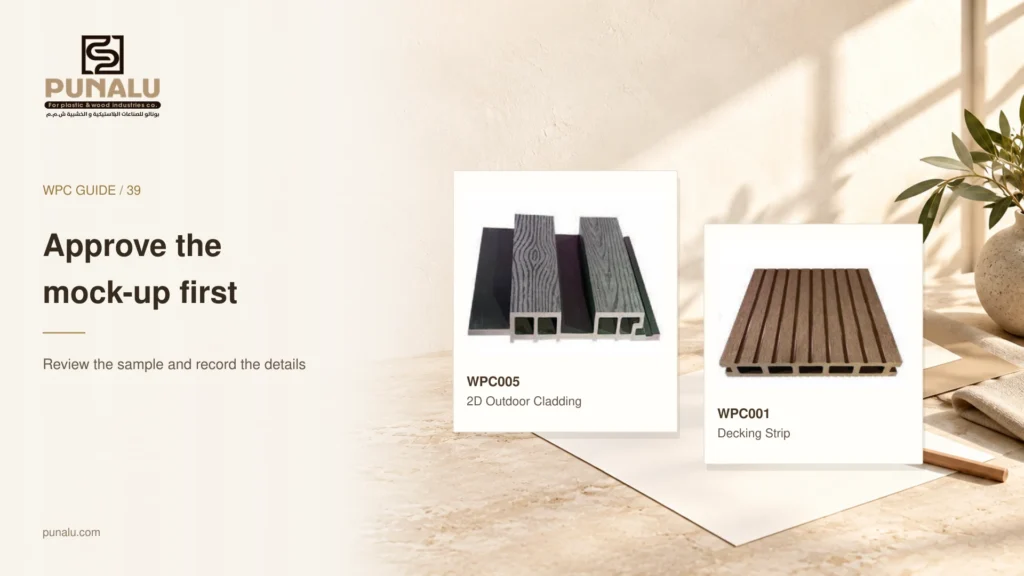
A WPC sample helps you understand colour and texture. A mock-up goes further by showing how the selected material meets a joint, corner or adjacent finish. For a visible entrance, façade or commercial terrace, this small assembly can resolve design questions before the full order. Make the mock-up representative of the intended work, with a clear purpose and an agreed approval record.
Decide what needs approval
List the decisions the mock-up should settle. These might include profile selection, board direction, colour coordination, visible fixings or a finishing detail. Avoid building a sample panel without defining what the team will assess. Approval of appearance should remain distinct from approval of engineering performance or compliance; those responsibilities belong with the appropriate project professionals and the required product documentation.
Use the actual proposed products
Select the material from PUNALU’s catalog and record the exact product code and finish. Use the proposed adjoining materials wherever possible. A substitute sample with a similar brown colour cannot reliably demonstrate the profile, connection or appearance of the product that will be ordered. Keep the supplier’s product information beside the mock-up so that the physical assembly and written reference stay connected.
Include a meaningful junction
Choose a section that reveals the difficult detail rather than only the easiest centre area. For cladding, this may include an opening return or outside corner. For decking, it may include the agreed edge detail and a joint. Review PUNALU’s wall panels or flooring products as appropriate, then ask the installer to use the proposed compatible components and applicable installation information.
Review it in realistic conditions
Place or assess the mock-up under representative lighting and at normal viewing distances. Look at the surface straight on and from the main approach direction. Consider how a repeated pattern will continue beyond the sample. If artificial lighting is central to the design, review its effect before approval. A close-up image alone may conceal the visual impact of joints across a larger wall or terrace.
Invite the right people
The client, designer, installer and material supplier may each need to resolve different questions. Agree who approves the appearance and who checks the construction detail. Record comments clearly, including any change that requires a revised sample. The existing guide to choosing WPC before purchasing provides useful context for keeping material selection connected with the intended application and the complete supply package.
Keep the approval specific
Record the date, product code, colour reference, orientation, finishing pieces and accepted detail. Photograph the approved arrangement and identify any qualifications. Do not write a vague note that simply says “sample approved” if the joint or fixing method remains unresolved. If a product or component changes later, ask whether the affected part of the mock-up needs to be reviewed again.
Connect the sample to the order
Use the approved references in the final material schedule, quotation and installer briefing. Keep the sample available where practical so the team can compare subsequent work with the agreed appearance. The broader WPC cladding system article reinforces why the visible panel and its installation proposal should be reviewed together. A mock-up supports that conversation without replacing the other project checks.
Control changes after approval
Give the accepted mock-up a reference and identify the drawing revision it represents. If the board, finish or fixing detail changes, record which aspect needs another review. A new colour may affect appearance approval, while a changed connection can require a separate technical check. Keeping those decisions distinct prevents an old approval photograph from being used as evidence for a combination of materials and details that was never actually reviewed. Keep that reference accessible.
Contact PUNALU with the proposed product references and the detail you want to demonstrate. A focused mock-up gives the team something concrete to assess, improves the clarity of the material order and reduces the chance that an important appearance decision is left until the main installation is already underway.