
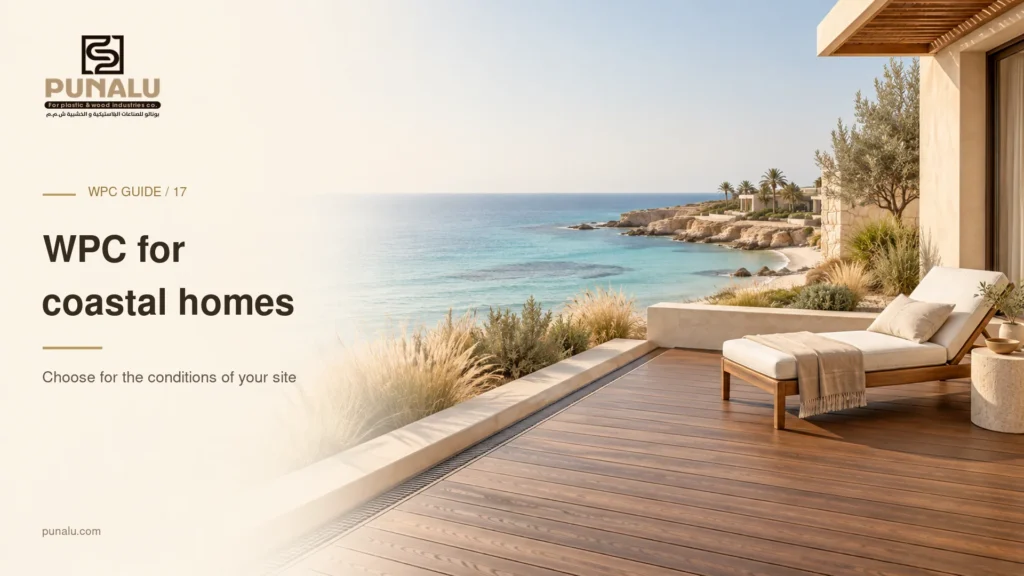
A coastal terrace has a different daily routine from a sheltered city courtyard. Wind carries sand, furniture moves between sun and shade, and people return from the beach with wet feet. Choosing WPC for a coastal home therefore starts with a description of the actual space, rather than a promise that one material is suitable for every seaside project.
This guide helps you prepare that description, compare samples and ask useful questions before ordering. It is relevant to a holiday apartment balcony, a villa terrace or an outdoor seating area. Product approval, structural design and installation details still need to come from the people responsible for the specific system.
Start with exposure rather than the coastal address
Two properties in the same development can have very different conditions. A recessed balcony may receive little direct rain, while an open terrace can face wind-driven moisture and strong afternoon sun. Record whether the proposed deck is covered, how water leaves the area and where sand tends to collect.
Also distinguish a private terrace from a shared access route. A small family seating area and a busy rental property will have different cleaning routines and levels of use. Put these details in the supplier enquiry so that product selection responds to the project instead of relying on a generic description such as “outdoor grade.”
Ask for the exact product specification
WPC is a material category, not a single specification. Ask for the product name, intended application, board dimensions, surface type and installation instructions. For PUNALU, compare the available hollow decking profiles and request the installation information for each selected code. Similar appearance does not establish equal performance.
For coastal use, ask whether the proposed application is covered by the supplier’s documentation and warranty. Describe the location accurately, including any pool, frequent washing or exposed edge. Keep the written answer with the quotation. A verbal assurance that a board is “suitable for the sea” is less useful than a clear statement about the exact product and its conditions of use.
Treat the supporting system as part of the purchase
The visible boards are only part of the assembly. The subframe, screws, clips, connectors and edge trims all need to be selected for the project. Ask the contractor to identify these components by specification, including the fastening materials and any requirements for contact between different metals.
Do not assume that a corrosion-resistant description applies to every component in a quotation. Have the contractor explain the selection and confirm compatibility with the board manufacturer’s instructions. The goal is a coordinated system with traceable components, not a collection of individually attractive products.
Access also matters. If a drain or connection needs inspection, agree how it will remain reachable after the deck is finished. Photograph the support layout before boards conceal it and keep those photographs with the handover documents.
Review drainage and cleaning together
A terrace should have a clear water route. Ask the project team to show how surface water, rain reaching the substrate and routine cleaning water will leave the area. The deck layout should be coordinated with existing drainage and waterproofing details rather than used to hide an unresolved problem.
Think about the cleaning tools that will actually be available. Where will sand be swept? Can the area be rinsed without directing dirty water into a doorway? Are narrow corners reachable with a soft brush? These questions are especially useful in a holiday home that may be closed for weeks between visits.
Request a care sheet for the exact product. Do not select a pressure setting or chemical cleaner solely because it worked on another composite deck. Keep the agreed cleaning method simple enough for the person who will maintain the property.
Compare colours in the actual light
Photographs are useful for narrowing a palette, but a physical sample makes a better final decision. Place samples beside the façade, window frames, pool coping or paving. Look at them in morning and afternoon light and decide whether the overall effect should be quiet and continuous or more contrasting.
Ask about surface temperature expectations without treating a colour name as a guarantee of comfort. Where people may walk barefoot, shade planning and a realistic trial of the selected sample are worth discussing. Record the chosen colour code and texture, not only a photograph or a description such as “light brown.”
For a large project, agree how batches will be checked and how spare material will be stored. This makes future maintenance easier even when the visual match between production batches cannot be promised.
Prepare a coastal project checklist
Before accepting a quotation, collect answers to these questions:
- What exact profile and colour are being offered?
- Is the proposed coastal application addressed in the product documentation?
- Which subframe, clips, fasteners and trims form the complete system?
- Who will approve the substrate, drainage and waterproofing details?
- How will drains, access panels and exposed edges be finished?
- What cleaning method should the property manager use?
- Which warranty applies, and what records must the owner retain?
Ask for any exclusions to be written beside the relevant item. This is easier to review than discovering later that a quotation covered boards but omitted the components needed to finish the perimeter.
Frequently asked questions
Is every WPC board suitable for a seaside terrace?
No category label can confirm that. Check the exact board’s intended use, installation requirements and warranty, then verify the rest of the supporting system for the project’s exposure.
How should I choose a PUNALU profile for a coastal deck?
Profile selection depends on the documented system and the project. Compare the available hollow profiles using their current instructions, edge details and permitted applications. Ask PUNALU and your project professional to confirm suitability for the specific location.
Can I leave a holiday-home deck without maintenance?
Plan a realistic inspection and cleaning routine. Agree who checks drains, removes accumulated debris and reports loose or damaged components, especially when the property is not occupied continuously.
Discuss the material package with PUNALU
Send PUNALU the approximate area, site photographs, exposure description and intended use. Request the relevant material options and documentation, then coordinate the final specification with your contractor. A clear brief helps turn a coastal design idea into an order that can be checked, delivered and maintained with fewer unanswered questions.
Sources and product guidance
Use the selected product documentation. Other manufacturers’ guidance applies to their own products.