
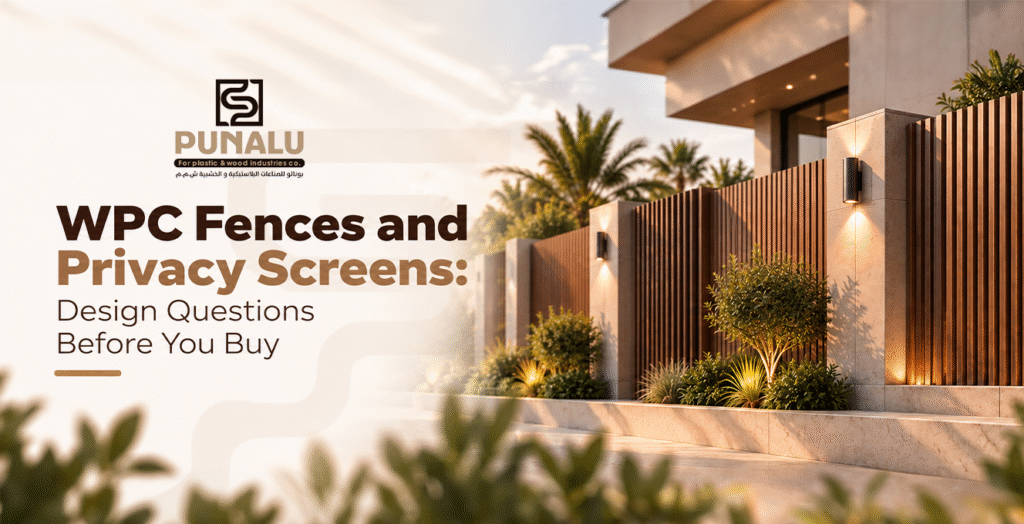
A fence or privacy screen can do much more than close a boundary. It can organise an outdoor seating area, define a garden, protect a service zone from view, guide movement in a hospitality space, or create a more comfortable transition between neighbouring areas. WPC profiles can support these design objectives when the system is selected for the actual site.
Before choosing a colour or pattern, define the privacy level, dimensions, visibility, support conditions, and relationship with the wider landscape or architecture. This guide gives you the questions that create a more reliable WPC fence or screen brief.
Define the privacy objective
Start with the exact purpose. Do you need a full boundary, partial screening, a visual divider, a decorative backdrop, or a way to hide an equipment or service area? The answer determines the height, profile orientation, spacing, and whether the screen should be open, semi-open, or visually solid.
Privacy is not always about closing every gap. In some projects, controlled spacing allows light and air while reducing direct sightlines. In others, a more enclosed result is required. Explain the desired effect before asking a supplier to recommend a profile.
Check height, support, and fixing conditions
A fence or screen is affected by its height, length, wind exposure, support posts, base condition, and fixing detail. The visible WPC boards must be considered alongside the structure that holds them. Do not assume that a decorative image automatically describes a buildable system.
Share a site plan, dimensions, photographs, and information about the ground, walls, or existing supports. If the screen is large or exposed, coordinate with the qualified parties responsible for structural and local compliance decisions.
Choose the right spacing and profile direction
Horizontal, vertical, and louvred arrangements create different visual and privacy effects. Spacing between elements changes the balance between screening, airflow, light, and view. Use a sample or simple mock-up to see the design from both sides, especially when the screen is visible to neighbours or guests.
Colour and texture should also be reviewed in the actual site light. The selected finish needs to work with planting, paving, walls, gates, and nearby architecture. A screen becomes more convincing when it feels integrated with the space rather than added at the end.
Use screens to organise outdoor areas
WPC screens can create separate zones for seating, dining, pool use, circulation, storage, or service access. In restaurants, hotels, and clubs, they can support guest flow and visual comfort. In villas and chalets, they can help define a terrace or garden without making the space feel completely enclosed.
If the project has multiple areas, share a simple movement plan or site photographs with the supplier. A repeatable screen system may help create a consistent design language across more than one zone.
From concept to installation
Begin with the site photos, dimensions, desired height, privacy requirement, and a reference image if you have one. Then request a sample, proposed fixing detail, and quotation that identifies the profiles, supports, accessories, delivery, and installation scope.
With those steps, a WPC fence or screen becomes an integrated architectural element instead of a last-minute boundary solution. The result can support privacy without ignoring the overall design of the space.
Frequently Asked Questions
Can WPC screens be used as dividers inside a terrace?
Yes. A WPC screen can separate seating or service zones when its height, spacing, fixing, and overall design suit the application.
Does a WPC fence need to be fully closed?
Not always. The required privacy, airflow, light, view, and design concept determine whether the screen is solid, semi-open, or louvred.
Next Step for Your Project
Send PUNALO the boundary or screen dimensions, site photos, and your required privacy level. We can help you develop the right profile, spacing, sample, and scope for the project.