
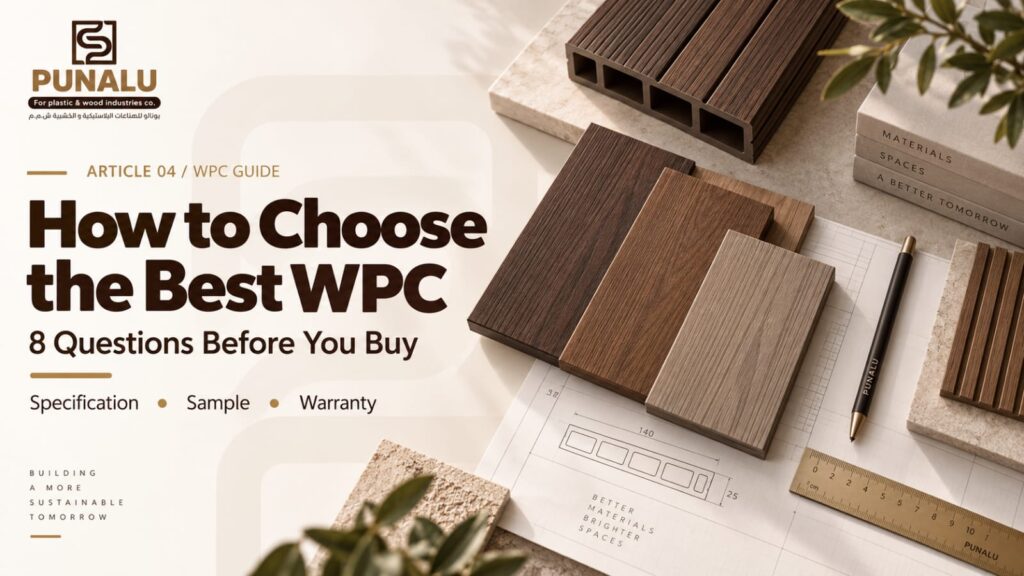
There is no single “best WPC” for every buyer. The right product is the one that matches the project type, expected use, budget, installation system, and written specification you can review. Many comparisons begin with colour or price and miss the questions that protect the buyer after the order is placed.
This guide provides eight practical questions you can use with any manufacturer or supplier. Keep them for a showroom visit, a contractor meeting, or a quotation request, then use the answers to compare samples and offers on a more professional basis.
1. What is the real use case?
Is the project an outdoor deck, façade, pergola, fence, privacy screen, or door? Each application can require a different profile and fixing system. Do not ask for “WPC boards” in general; explain where the product will be installed, who will use it, and whether the area has water exposure, continuous foot traffic, special heights, or specific privacy needs.
When the use is defined from the beginning, unsuitable profiles can be removed early. That is far better than choosing a visually attractive solution that does not have a considered functional basis.
2. What are the material inputs and specification?
Ask about the WPC composition, the profile data sheet, the intended application, and how consistency is checked. The aim is not to memorise technical terms; it is to establish that the product has a clear source and a specification that can be reviewed. If the answer is only a broad claim, request more detail or a documented sample.
Follow with another question: how are colour, dimensions, and surface quality checked? A visible production-control process gives you a stronger basis for comparison than a generic statement about quality.
3. Is the profile right for the load and substrate?
For decking, do not assess the board separately from the base, support structure, clips, and drainage. For cladding, ask about the fixing system, ventilation, corners, openings, and expansion details. Pergolas and fences need a clear understanding of support points, heights, spans, and the design as a whole.
Ask for a detail drawing, installation explanation, or system sketch rather than only a final-project image. It helps reveal whether the offer includes what the project genuinely needs or leaves important costs and decisions for later.
4. How does the colour and texture look on site?
Do not approve a finish from a phone screen. Request a sample and inspect it in daylight and shade where possible. Hold it against the project’s stone, paint, aluminium, landscaping, and other finishes. Board width and surface texture can influence the final appearance much more than they seem to in a catalogue.
For larger projects, approve a clear reference sample before ordering. That gives the client, designer, and installation team a shared visual benchmark for the expected finish.
5. What does the warranty cover?
A warranty duration alone is not enough. Ask what it covers, how a claim is made, and which conditions apply to installation and use. Clear warranty terms are part of the purchasing decision, especially when the project is large or the buyer is accountable to an end client.
Request the written terms and review them before approval. If the project expects performance beyond normal use, discuss that condition early rather than assuming that every event is automatically covered.
6. Are you dealing with a manufacturer or a seller only?
Knowing the source of the product helps you understand supply continuity, profile availability, technical support, and the ability to obtain matching accessories later. This does not mean every distributor is unsuitable, but it makes one question essential: who is responsible if the project needs a technical answer or additional quantities?
PUNALO’s manufacturing story should be supported by verifiable product and factory information. Use the same standard with every alternative: the source should be clear enough to support the specification, not merely a sales slogan.
7. Does the quotation include accessories and installation?
Request a clear inclusion list: boards, clips, screws, edge profiles, subframe, delivery, installation, cutting, and finishing. The lowest quoted rate may be incomplete, so it cannot be compared fairly with a price that covers the whole system.
The goal is not the longest list of line items. It is to understand what is genuinely required to deliver the intended result without unplanned additions later in the project.
8. Can you see a real application or request a sample?
A sample and a real reference installation can give more confidence than marketing imagery alone. Ask to see a comparable project or review the sample in the same type of light and surrounding materials as your own site.
After answering these eight questions, you can choose the best WPC for your project with greater clarity and less reliance on appearance or price alone.
Frequently Asked Questions
Does the lowest price mean the best offer?
No. Compare offers only after confirming that the profile, accessories, installation scope, and warranty terms are equivalent or that the differences are clearly understood.
Do I need a sample before buying WPC?
Yes. A physical sample helps you review colour, texture, and profile shape before approval, especially for a large area.
Next Step for Your Project
Send PUNALO the project type, dimensions, and site photos. We can help structure the questions, compare the scope, and identify the sample or profile that should be reviewed next.