
A good WPC order starts with a clear description of the finished work. Sending only an area and a colour preference may produce a preliminary price, but it leaves important questions about profiles, lengths, accessories and quantities unresolved. A structured enquiry helps the supplier quote accurately and gives the installer a material list that can be checked.
This guide explains how to prepare a WPC material order for decking, cladding or related project elements. It separates the information you can gather from the technical decisions that your contractor or designer needs to approve before purchase.
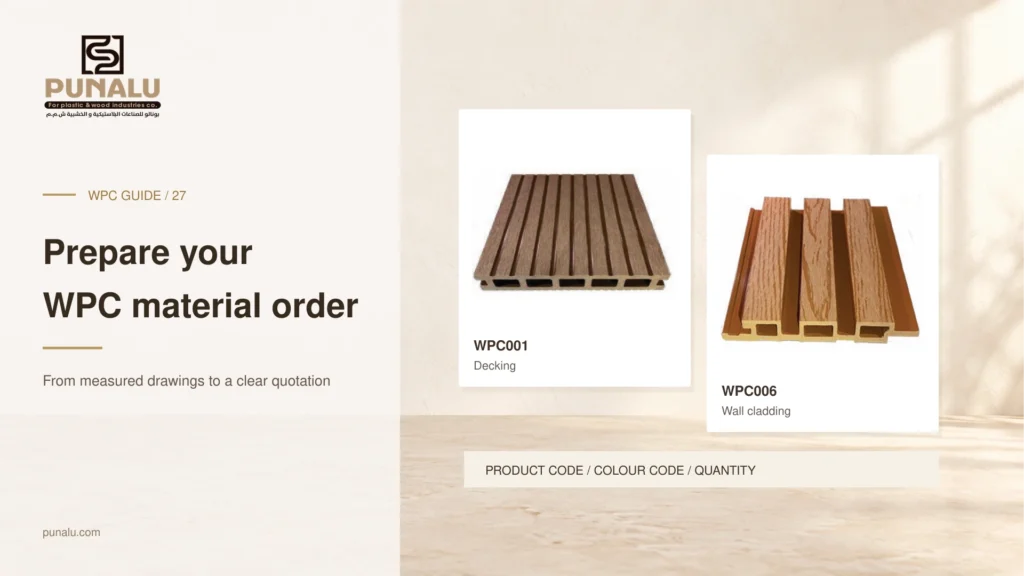
Use a separate line for each PUNALU product code. For example, identify WPC001 as a decking selection and WPC006 as a wall-cladding selection rather than grouping both under “WPC boards.” Confirm the finish, color and current specification for each line. These examples identify catalog products, not a recommendation to use either profile for every project.
Define the application and the project areas
Begin by identifying what you are ordering for: a deck, wall cladding, screening element or another documented application. If the project contains several uses, list them separately. A shared colour theme does not mean that one profile or fastening system suits every location.
Give each area a simple name, such as “main terrace” or “entrance wall.” Use the same names on drawings, photographs and quotations. This makes it easier to discuss a change without confusing the material intended for one area with material assigned to another.
Describe the environment and intended use. Include relevant information about exposure, residential or commercial operation, access and any nearby pool or coastal conditions. The supplier needs this context to identify the applicable product information.
Measure and document the layout
Prepare a drawing with dimensions, openings, corners and fixed obstacles. For decking, show the proposed board direction and visible edges. For cladding, show the panel orientation, wall openings and return details. Ask the installer to verify measurements before the final take-off is approved.
Photographs help explain the site but do not replace measured information. Label them with the area names and indicate any detail that affects the order, such as a narrow access route, an irregular wall or a drain that must remain reachable.
Record the drawing revision used for pricing. If the layout changes, ask for the quantities to be reviewed against the new revision. This prevents an apparently minor design change from being overlooked in the material order.
Specify the product beyond its colour
List the product code, profile, dimensions, available length, surface and colour code. Attach the approved sample reference where possible. Descriptions such as “wood look” or “dark brown WPC” are useful starting points, but they are not precise enough for a final purchase order.
Confirm whether the quoted dimensions describe the overall profile or the effective coverage after installation. This distinction can matter when converting a wall or deck area into a purchase quantity. Ask the supplier and installer to use the same basis in the schedule.
If a product is still provisional, label it clearly. Do not allow an unconfirmed sample choice to become an order merely because it appeared in an early estimate or design mood board.
Calculate quantities from the approved arrangement
The layout, available lengths and cutting plan should guide the final quantity. Two areas with equal square metres can require different numbers of boards because their shapes and joint arrangements differ. Have the installer prepare or check the take-off for the proposed system.
A simple arithmetic example shows why units need to be clear. If a hypothetical panel provides 0.5 square metres of effective coverage, a 10-square-metre rectangle would require 20 panels before allowing for cuts, layout or spares. This is an illustration only; use the actual product’s coverage and project drawing for the order.
Separate cutting allowance from spare material retained for maintenance. Ask how each allowance was determined instead of applying a universal percentage. Keep reusable offcuts visible in the cutting plan where relevant, but do not assume every short piece can serve a permitted detail.
Add the complete accessory package
Ask the contractor to list the compatible supporting components, clips, screws, connectors and trims required by the system. Include starting and finishing details, corners, exposed ends and any planned access section. These items should not disappear inside a vague line labelled “accessories.”
Identify who supplies each component. Some items may come from the WPC supplier and others from the contractor or a specialist trade. Mark those boundaries in the schedule so that the complete assembly has no gaps between packages.
Confirm substitutions before ordering them. If a specified component is unavailable, ask for the proposed alternative and written compatibility confirmation. A late change should be reflected in the schedule and the installation information.
Make quotations easy to compare
Send the same material schedule to each supplier being considered. Request quantities, units, product codes, included accessories, delivery arrangements and any exclusions. Keep material supply separate from installation services so that the scope is clear.
Review the quotation against the schedule line by line. Ask about differences rather than assuming that a lower total reflects the same package. One offer may omit trims, use another board length or calculate coverage differently.
Confirm current availability, lead time and the validity of the quotation directly with the supplier. These are purchasing details that can change, so they should be settled for the actual order rather than taken from an old catalogue or article.
Plan delivery, checking and storage
Check the route from the delivery vehicle to the storage area. Long boards may require different handling arrangements from small accessories. Tell the supplier about access restrictions and coordinate unloading responsibilities with the site team.
Follow the product’s storage instructions and agree where the materials will remain until installation. At receipt, check the order reference, product codes, quantities and visible condition. Record any discrepancy promptly using photographs and the supplier’s reporting process.
Keep packaging labels and batch information where available. Separate the material by project area if that helps the installation sequence, and protect retained spares according to the relevant instructions.
Frequently asked questions
Is the area measurement enough to place an order?
It is enough for an early discussion, but the final order should reflect the layout, product dimensions, cutting plan and complete accessories. Ask the installer to verify the take-off.
Should I add the same waste percentage to every project?
No. Shape, board lengths, direction and details affect the allowance. Agree a project-specific quantity and distinguish cutting needs from maintenance spares.
What should I send for a useful quotation?
Send the application, measured drawing, site photographs, product or sample preferences, required accessories and delivery location. Mark any technical decision that is still awaiting approval.
Send a clear enquiry to PUNALU
Share your area schedule, approved measurements and preferred material options with PUNALU. Request a quotation that identifies the offered products, accessories and supply scope, then have your contractor confirm quantities and compatibility before purchase. A clear order connects design choices to the materials that actually arrive on site.
Sources and product guidance
Use the selected product documentation. Other manufacturers’ guidance applies to their own products.